
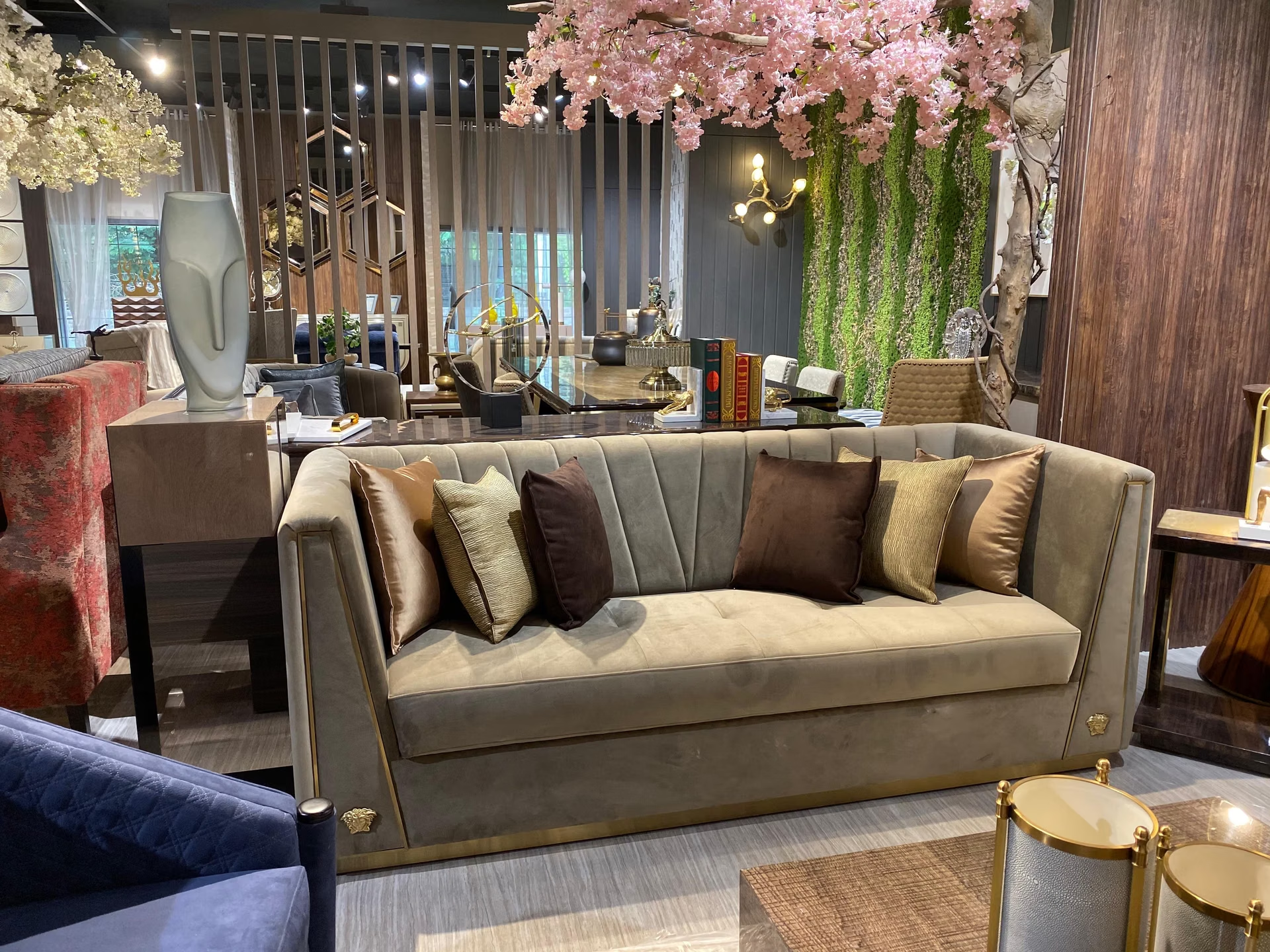
A 3-seater is not a specification. A sofa is specified by seven numbers: overall length, overall depth, seat height, seat depth, back height, arm height and leg height. Two sofas sold as 3-seaters can differ by 400mm. This guide gives you the real ranges, the fabric maths and a specification sheet you can copy.
You have been told the maker can build anything, and nobody will tell you what to ask for. You know a 3-seater is not a measurement. You have just never been given the list of things that are. This is that list — the one a factory works from, in plain words.
This is not a guide to choosing a sofa. If you are still deciding, read the custom sofa buying guide for India first. This page is about the document you hand over afterwards.
Why “3-Seater” Is Not a Specification
A seat count tells a maker almost nothing. Two sofas both sold as three-seaters can measure 2,000mm and 2,400mm from arm to arm. That is a 400mm difference — the width of a person. One of them fits your wall and one of them blocks a doorway, and the label on both says the same thing.
Seat count also hides the sit. A 2,300mm sofa with a 550mm seat depth and a 900mm back is a formal piece you sit upright in. The same 2,300mm with a 680mm depth and a 720mm back is something you lie down on. Same label. Different furniture.
Write those seven numbers down and a maker anywhere can build to them. Leave them out and you are trusting somebody else's default. The most common failure in a sofa brief is exactly this: a piece specified by “3-seater” instead of by overall length and seat depth.
The Seven Sofa Dimensions That Decide Whether You Like It
Here are the seven, with the range each usefully lives in and what changes when you move it. Every figure is in millimetres: a sofa specified in inches and built in millimetres has a rounding error in it.
| Dimension | Usable range | What changes when you move it |
|---|---|---|
| Seat height — floor to top of seat cushion | 420–450mm | Lower reads as lounge and is harder to rise from. Higher is easier to stand up from. Over 450mm most feet dangle. Under 400mm older knees suffer. |
| Seat depth — cushion front to the face of the back cushion | 550–650mm | Under 550mm you perch. Over 620mm your back leaves the backrest unless you add a bolster. |
| Overall depth — front of arm to back of frame | 900–1,100mm | This is the number that has to pass through your door. It also eats walkway before it earns comfort. |
| Back height — floor to top of the back | 750–900mm, or 1,050mm+ for head support | A low back keeps a view or a window open. A high back supports a head. Nothing between 900 and 1,050mm supports a neck — it only blocks the room. |
| Arm height — floor to top of arm | 600–650mm standard · 550mm low | 600–650mm sits comfortably under the back and holds a glass. 550mm lets you lie down with a cushion under your head. |
| Overall length — outside arm to outside arm | Two-seat 1,600–1,850mm · Three-seat 2,000–2,400mm · Large three 2,400–2,700mm | Allow 550–650mm of clear cushion per person between the arms. Arms typically add 150–250mm each. |
| Leg height — and the clear space under the frame | 100–200mm | Under 100mm the room reads heavy and nothing can be cleaned under it. 150mm and above lets a vacuum head pass and lifts the whole piece visually. |
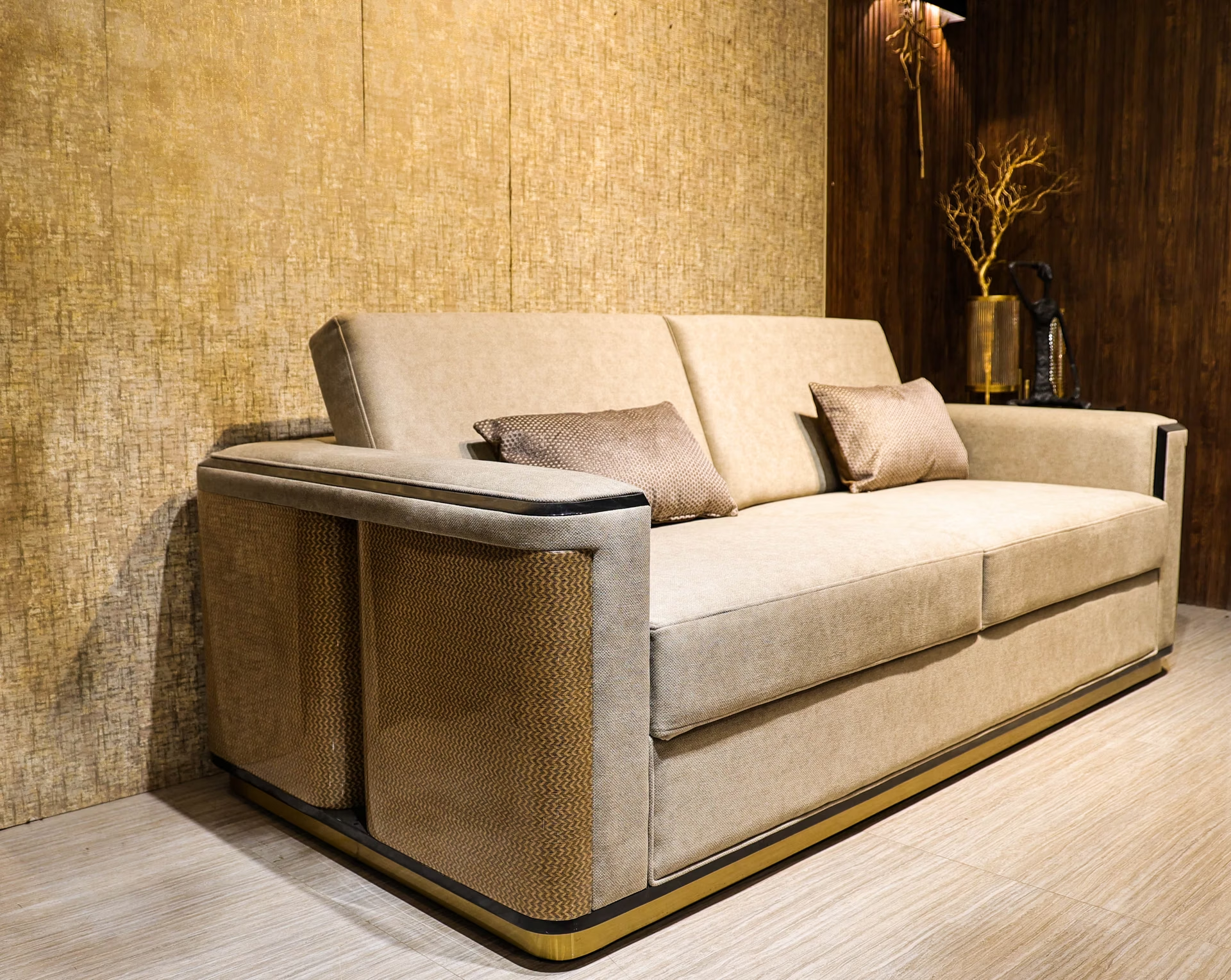
Sofa Seat Depth and Seat Height: How the Numbers Feel
Seat height is the number your body notices first. At 420mm you sink and settle. At 450mm you rise easily and your feet sit flat. Over 450mm, most adults find their heels leave the floor and the cushion edge presses into the thigh. Below 400mm, standing up becomes a daily event for older knees.
Also say whether your seat height is measured compressed or uncompressed. Foam settles under weight. An uncompressed 460mm cushion can sit at 430mm with a person on it. Two people measuring the same sofa two different ways will argue over a piece that is actually correct.
Seat depth decides posture. Under 550mm you perch on the front edge. Between 550mm and 620mm most people sit upright with their back against the backrest and their feet on the floor. Over 620mm you gain lounging and lose upright sitting: your lower back can no longer reach the back cushion.
The honest fix for a deep sofa is not a stiffer back. It is a lumbar cushion or a bolster. A 500 × 200mm bolster takes 100mm out of a 680mm seat depth when you want to sit up, and goes away when you want to lie down. A firmer back just gives you a hard sofa that is still too deep.
A sofa is not a word. It is seven numbers, a fabric, a frame, and a door it has to fit through.
Sofa Length: How Many People Actually Fit
Count seats in millimetres of clear cushion, not in labels. A person needs 550mm to 650mm of cushion width to sit without touching a neighbour. Below 550mm, shoulders overlap. Above 650mm, you have bought more sofa than you have people.
- Two-seat: 1,600–1,850mm overall. Around 1,200–1,400mm of clear cushion, plus arms.
- Three-seat: 2,000–2,400mm overall. Around 1,650–1,950mm of clear cushion. This is the range most three-seaters live in, and it is why two of them can differ by 400mm.
- Large three: 2,400–2,700mm overall. Genuinely seats three adults with room, or two adults lying at angles.
- Anything over 2,700mm should be checked against the delivery route before it is drawn, not after.
One more length rule. A bench cushion spanning 1,950mm is one piece of foam with no support at its centre. Individual cushions at 650mm each span nothing. That choice decides how the sofa looks in five years.
Cushion Configuration and Fill: What It Looks Like in Five Years
There are two honest options for the seat, and they age in opposite directions.
A bench seat — one cushion across the whole width — looks cleaner. No seams break the line, and the sofa reads as one object. It also sags as one object, and there is nothing to rotate.
Individual cushions break the line with a seam every 550–650mm. In return they can be turned, rotated end to end, and swapped one for one when a single cushion wears. That is why they age better.
Fill is the second half, and every fill trades support against the look of a lived-in sofa.
- High-resilience foam. The most supportive option, and the one that holds its shape longest. It springs back rather than compressing flat. It also looks the most tailored and the least soft.
- Feather-wrapped foam. A foam core with a feather-and-fibre wrap. It has a foam's support and a feather's surface. It looks lived-in inside a week and needs plumping most days to look sharp.
- All feather or feather-and-down. The softest sit there is. It also needs the most attention, and it will look crumpled within an hour of anybody sitting on it.
Here is the trade-off nobody says out loud. A sofa that sits beautifully and a sofa that looks beautiful in a photograph at 6pm are not the same sofa. Feather sits like a cloud and looks used. High-resilience foam looks crisp and feels firmer than a soft brief expects. Choose one, and write it down.
The Sofa Frame: The Part You Never See
The frame is the only part of a sofa that cannot be fixed later. Fabric can be replaced. Cushions can be refilled. Legs can be changed. A frame that has twisted is a sofa that has ended, and you will not see it happen because it happens under the upholstery.
Specify kiln-dried hardwood at 8–12% moisture content. That range matters more in India than almost anywhere. Our air swings from roughly 30% relative humidity in a dry summer to 85% in a monsoon month. Wood moves across the grain with that swing. Timber that goes into a frame at 16% or 18% is still drying while the sofa is built, and it keeps drying in your room. Joints loosen, rails twist and the sofa develops a creak that no upholsterer can reach. Unseasoned wood in a frame is the single most common cause of sofa failure in Indian conditions, and it is invisible on the showroom floor.
Then specify the joint. It separates a frame that lasts decades from one that lasts a lease.
| Frame joint | What it is | How it behaves |
|---|---|---|
| Mortise and tenon | A cut tongue on one rail seated into a cut socket on the other, glued. | Mechanically locked. Load passes through wood, not fasteners. The strongest option and the slowest to make. |
| Dowelled, glued and corner-blocked | Dowels and glue at the joint, with a screwed and glued triangular block across the inside corner. | Very strong when the blocks are actually fitted. Ask for corner blocks by name — they are the first thing dropped to save time. |
| Stapled butt joint | Two rails pushed together and stapled through the face. | Held by metal in end grain. It works loose. This is the joint inside most cheap sofas and it is why they creak. |
Last, specify the seat platform — the thing under the cushion that does the actual carrying.
- Elastic or jute webbing. Interwoven straps across the seat rails. Light, springy and shallow. It gives a softer, more forgiving sit and lets you build a slim sofa.
- Sinuous springs. Zig-zag steel wires clipped front to back. Firmer and more even than webbing, quieter than coils, and the most common choice for a tailored sofa.
- Coil-sprung platform, hand-tied. Individual coils tied together and to the frame. The deepest, most cushioned sit, the heaviest sofa and the most labour. It also lasts longest.
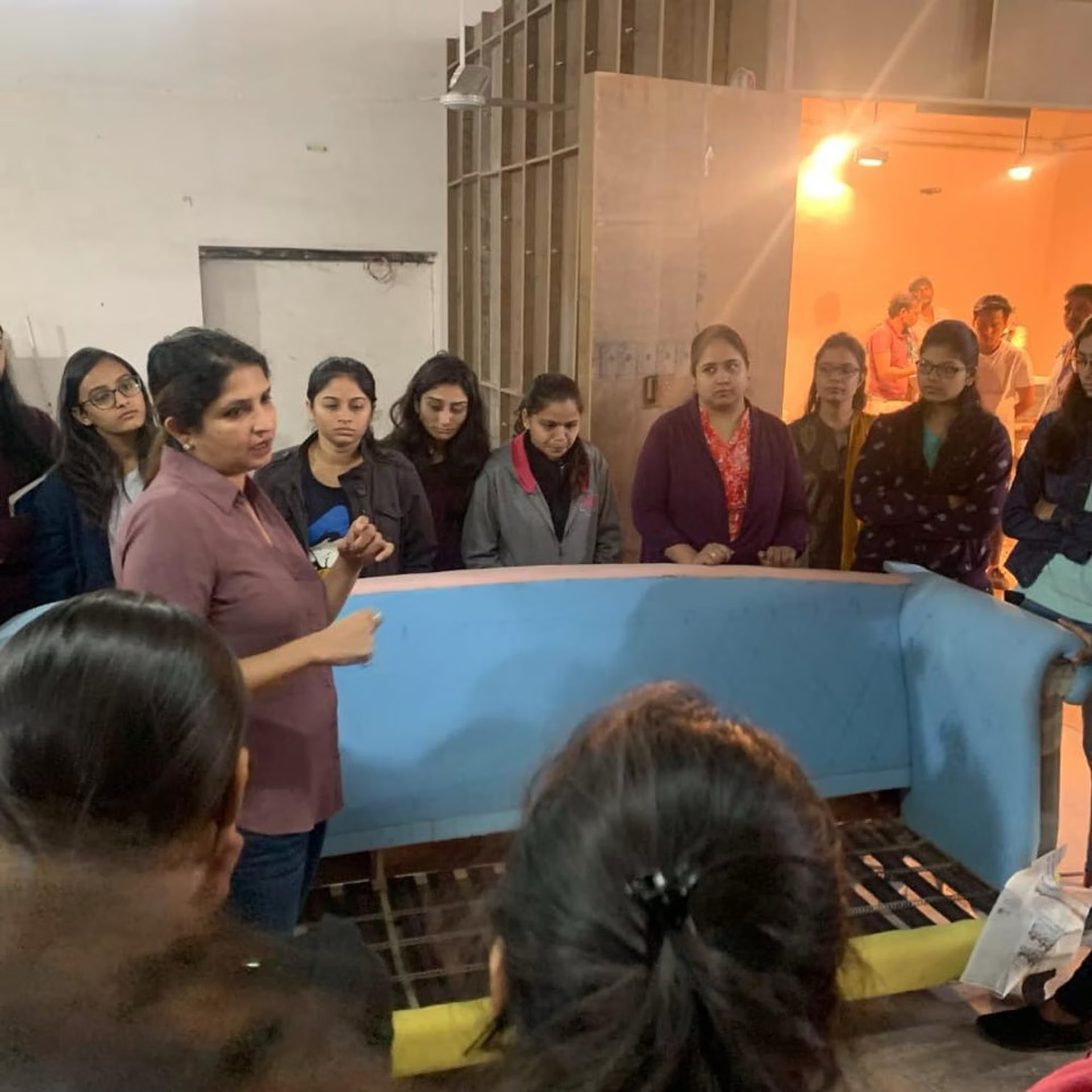
Send us a room, a plan or a photograph. We draw the sofa to your millimetres and you approve it before anything is cut.
Start a custom sofa →Custom Sofa Upholstery Fabric Quantity: How Much You Actually Need
Fabric is bought in metres and regretted in centimetres. Start with a rule of thumb, and treat it as exactly that: a three-seater of 2,000–2,400mm in a plain 140cm-wide fabric takes roughly 14 to 18 metres, including loose back cushions. It is an estimate for budgeting, not a cutting figure. The real number comes off the final drawing.
Three things push that number up, and all three surprise people.
- Pattern repeat. If the design repeats every 60cm, every panel has to be cut so the pattern lines up across each seam. The waste between usable cuts is real fabric that you still pay for. A large repeat commonly adds 20% to 30% to the metres.
- Nap direction. Velvet has a direction. Run one panel up and its neighbour down and the same dye reads as two different colours in the same light. Every panel on a sofa — and every panel across a whole matching suite — must be cut the same way. That constrains the cutting plan and can add metres even on a plain cloth. The fabric side of that decision is covered in velvet vs bouclé vs leather.
- Railroading. A railroaded fabric runs sideways off the roll, so a 2,300mm back can be cut in one piece with no seam. A fabric that cannot be railroaded needs either a seam in the middle of the back or more metres to avoid one. Ask the question before you fall in love with the cloth.
One more number to put in the specification: the Martindale rub count. In one plain sentence, it is how many rubs a fabric survives in a lab abrasion test before it wears through. For a main sofa in a home, ask for 25,000 rubs or more; for a sofa used hard every day, 40,000 and above. It measures abrasion only — not fading, not stains, not feel.
Leather: hides, lots and range marks
Leather is not bought in metres. It is bought in hides, and a hide is an animal, not a rectangle. Hides average 45 to 55 square feet each, with an irregular edge, a neck, a belly and a backbone line that all behave differently under a cutter. A good part of every hide is waste before anything is stitched.
As a rule of thumb, a three-seater takes roughly five to seven hides. But the more important rule is about the lot. Hides are tanned in batches, and two batches of the same colour will not match. An eight-seat sectional plus a matching chair should be cut from one lot, ordered together. Split it across two orders and the difference will land exactly where the eye goes.
And do not ask for leather with no marks. Range marks, healed scratches and small differences in grain are proof that the hide is real and not a printed coating on a split. A perfectly uniform surface across an entire sofa usually means a heavy pigment layer sitting on top of the leather. Read how to protect leather furniture before you choose a finish, and see tufted leather furniture if buttons are part of the design.
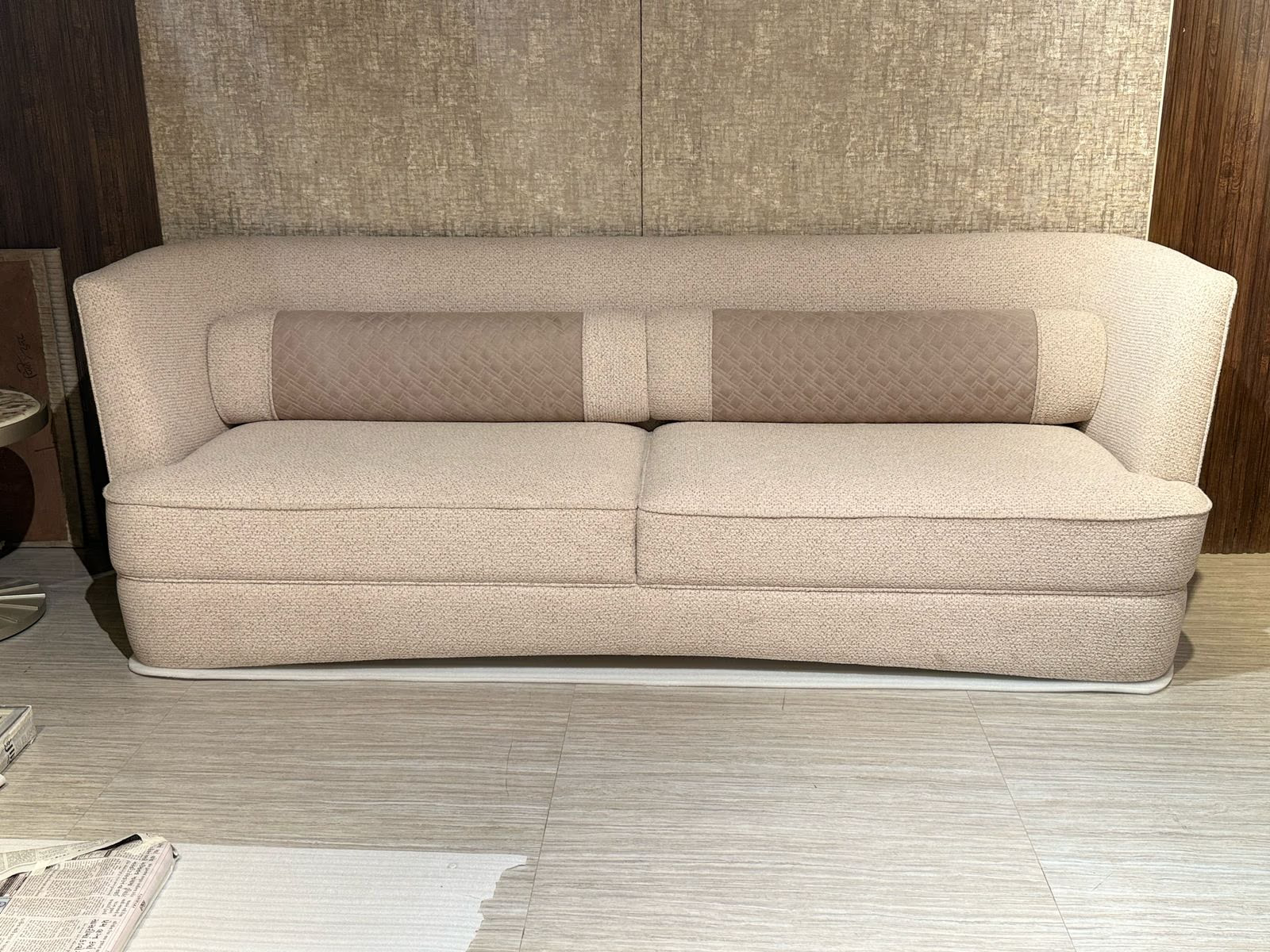
The Sofa Details That Get Missed
These lines never make it into a brief and always make it into the argument afterwards. Each is a decision somebody will make — you, or a person you have never met.
- Seam type. Piped in self fabric, piped in a contrast, plain, or French. Piping draws the shape and hides a slightly imperfect line. A plain seam is cleaner and far less forgiving.
- Stitch and thread colour. Matched to the fabric or deliberately contrasting. A contrast thread on a dark leather is a design decision, not an accident, and it must be written down.
- Buttons and tufting layout. How many, in what grid, how deep, and whether the buttons are covered in the same cloth. A diamond tuft on a 2,300mm back is a set-out drawing of its own.
- The back. Is the sofa seen from behind? If it floats in a room, the back must be finished like a front — same fabric, same seams. Against a wall it can be plainer. Say which.
- The underside. Dust cover fitted or open frame. Small thing. Visible forever on a sofa with 150mm legs.
- Legs. Material and finish — brushed brass, polished brass, lacquered wood, stained timber — plus height, and whether they unscrew for delivery. Bolt-on legs save a doorway more often than you would think.
- Does it come apart at all? A knock-down frame, a zip-off back, a sectional that splits into modules. Decide it now, because it changes how the frame is built.
Access and Delivery: Measure the Door Before You Sign the Drawing
This is the failure that costs the most and takes the least time to prevent. Measure the route before the drawing is approved, not after the sofa is built.
- The narrowest door on the route, measured as clear opening with the leaf open — not the frame size.
- The lift car: internal width, depth and diagonal, and the door opening, which is usually smaller than the car.
- The staircase: the width, and the turn. A half-landing with a 90-degree turn is where long sofas stop.
- The corridor: 900mm is a common width, and it decides whether a piece can be swung at all.
- The final doorway into the room, which is often narrower than the front door.
Here is the classic. A sofa is turned on its side to pass a door, so its overall depth becomes its height. A 900mm clear door and a 1,050mm-deep sofa is a sofa that stands in a corridor while somebody makes a phone call. Nothing about the sofa is wrong. The measurement was simply never taken.
When the route is tight, the answer is engineering, not hope. A knock-down frame bolts together inside the room. A zip-off back removes 200mm of depth for the journey. Removable legs buy 150mm of height. All of it must be designed in from the start — none of it can be added to a finished sofa.
Delivery anywhere in mainland India is free. That covers the crate, the road freight, transit insurance at full declared value, the e-way bill and the GST on all of it. There is no minimum order. Andaman & Nicobar and Lakshadweep go by sea at actual cost, and orders outside India are quoted per project. So you can put the right sofa in the drawing, not the one that ships cheaply.
The Sofa Specification Sheet You Can Copy
Copy this into your schedule and fill the right-hand column. Every line is something a maker needs before cutting. The worked example is an ordinary, buildable three-seater — use it for the format, then change the numbers.
| Line | What to write | Worked example |
|---|---|---|
| Overall length | mm, outside arm to outside arm | 2,300mm |
| Overall depth | mm, front of arm to back of frame | 980mm |
| Overall height | mm, floor to top of back | 820mm |
| Seat height | mm, floor to top of cushion — state compressed or uncompressed | 440mm uncompressed |
| Seat depth | mm, cushion front to face of back cushion | 600mm |
| Arm height and width | mm from floor, and arm thickness | 620mm high, 180mm wide |
| Arm style | Track, English roll, channel, scroll | Square track arm |
| Leg height and clear space | mm, and finish | 150mm, brushed brass |
| Seat cushions | Bench, or number of cushions | 3 individual cushions |
| Seat fill | Foam grade, wrap, feather or fibre | High-resilience foam core, feather-and-fibre wrap |
| Back cushions | Number, fill, fixed or loose | 3 loose, feather-and-fibre |
| Bolsters | Size and count | 2 at 500 × 200mm |
| Frame | Species, moisture content, joint type | Kiln-dried hardwood at 8–12% MC, mortise and tenon, corner-blocked |
| Seat platform | Webbing, sinuous springs or hand-tied coils | Sinuous springs over hardwood rails |
| Fabric | Name, colour, width, repeat, nap, Martindale, metres | Plain velvet, 140cm wide, no repeat, nap running down the seat, 40,000 rubs, ~16m |
| Seams | Plain, piped or French — and thread colour | Piped in self fabric, matched thread |
| Buttons / tufting | Layout, count, depth | None |
| Back finish | Finished both sides, or wall-facing | Fully finished — the back is seen |
| Underside | Dust cover or open frame | Black dust cover |
| Knock-down | Does it come apart, and where | Zip-off back, removable legs |
| Access route | Narrowest door, lift car, stair turn, corridor | 900mm clear door, no lift, one 90° stair turn |
If you have a CAD file, a floor plan or even a scaled PDF, send that too. A scaled drawing with dimensions on it beats a beautiful render with no sizes every single time. Our factory works from drawings, not from moods.
Approval: Nothing Is Cut Before You Approve
A specification is a promise on paper. Approval makes it real. Three gates are worth insisting on.
- A sample of the actual fabric or leather, in the actual room, in that room's light. Not a photograph, not a screen, not the same colour from a different lot. A swatch on a showroom table is a different colour from the same swatch by your window at 5pm.
- The piece drawn and approved before it is built. Plan, elevation and section, with every dimension from your specification written on it. If a number on the drawing does not match your sheet, that is the moment to catch it.
- Nothing is cut before you approve. Timber, fabric and hide are all cut after sign-off, never before. That is the point of the sequence.
That order — specify, draw, approve, sample, build — is how a sofa arrives looking like the one in your head. It is slower on paper and faster in real life, because nothing is remade.
Take the specification sheet above, fill it in, and send it with a plan or a photograph of the room. We will draw the sofa to your millimetres, put a sample of the real fabric in your hands, and cut nothing until you have said yes. Start at customization, see finished pieces in the shop, or look at how the materials behave over time in materials.